The mission
Wild hog surveillance across large Texas properties is currently a human with a truck and a spotlight. The platform flies pre-programmed search patterns, captures thermal imagery, runs classification on the aircraft, and sends real-time notifications, tracking movement patterns across flights instead of hoping to catch animals in the open.
What’s flight-proven
- Autonomous GPS waypoint navigation with 45+ minute endurance
- 2-mile range flight tested; ~60 km theoretical on the CUAV P8 telemetry link
- Long-range digital video via WFB-NG
- ROS offboard control from the companion computer
- Night operations with LED lighting
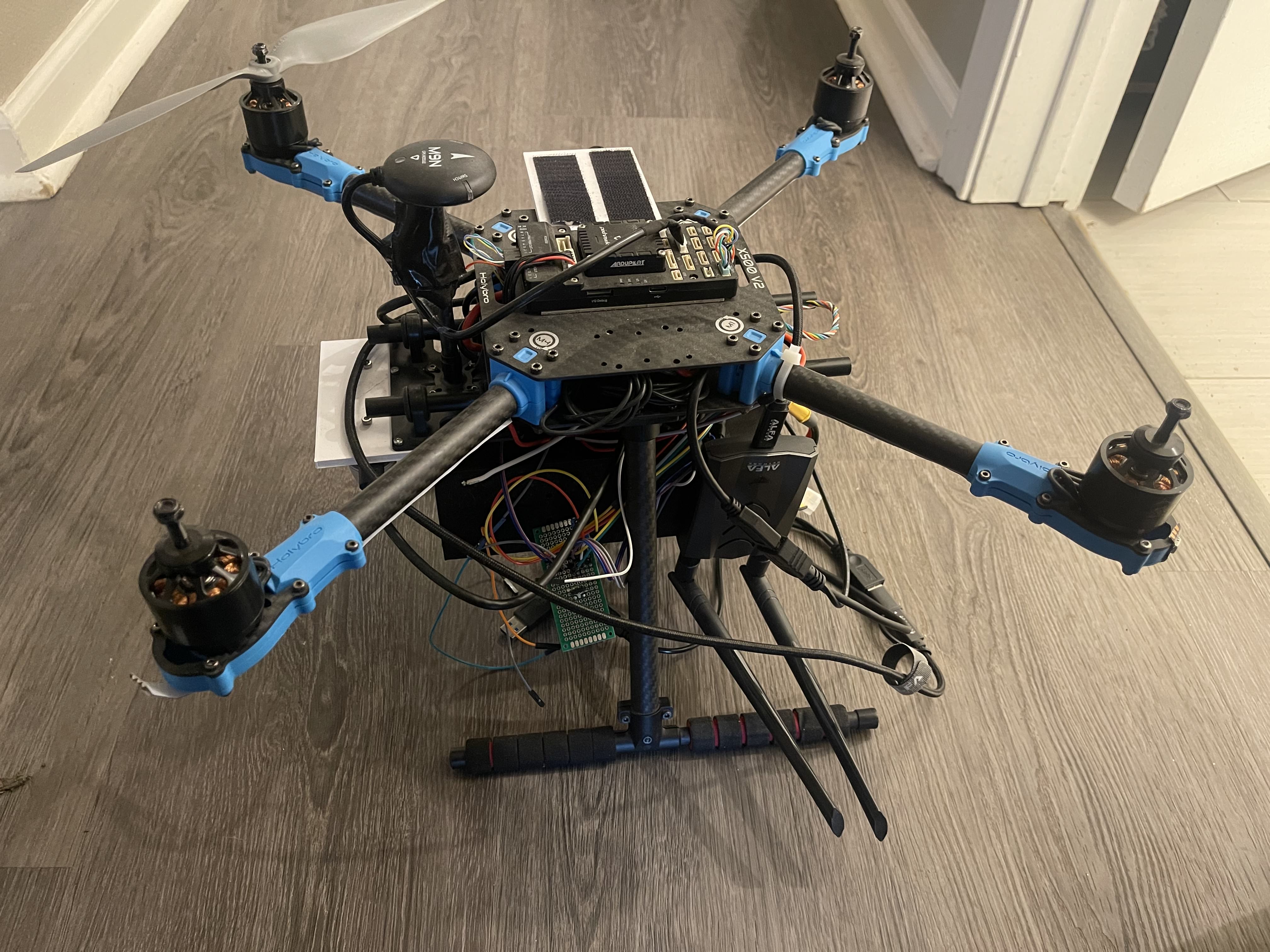
The airframe is a HolyBro X500 pushed to 10-inch arms with 12-inch props, Pixhawk 6x on PX4, with a Raspberry Pi 4 companion computer and a Jetson Orin Nano for inference. The FLIR Boson rides a 3D-printed mount (a proper gimbal is on the roadmap).
In development
Phase II work: precision landing (RealSense D435i + QR fiducials; depth-vs-FC altitude validation flights ran May 2026), integrating the thermal classifier, offboard-control guardrails, and the ground station build-out. Known gremlins being engineered out: ground loops on PDB-powered peripherals, and the Pi’s single Ethernet port being contested between the flight controller and the Jetson.
Simulation
In September 2026 I moved simulation off Gazebo and onto NVIDIA Isaac Sim. The sim drone runs real PX4 firmware (SITL, v1.15) through the Pegasus Simulator and talks to the same ROS 2 nodes, over the same uXRCE-DDS bridge, that fly the real aircraft. The first test was the hover-test node I use on the X500: it ran unmodified in Isaac Sim, flying a two-stage takeoff, a 15 ft hover, and a hand-off to PX4’s auto-land.
The point of the move is learned flight modules. Each phase of a flight (takeoff, cruise, landing) becomes a small neural policy that proposes velocity setpoints, wrapped in deterministic guardrails: speed caps, a descent rate tied to the height measured by the depth camera, hold-and-reacquire when the landing pad leaves the camera’s view, and a hand-coded final 35 cm of touchdown. PX4 still flies the setpoints. Isaac Lab trains thousands of simulated drones in parallel; the first landing policy took 18 minutes (20 million steps) on a desktop GPU. In a simplified test simulator with 2 to 6 m/s wind plus gusts, it landed in 50 of 50 runs against 33 of 50 for my hand-written controller, with a mean touchdown error of 0.20 m against 0.34 m. Next is flying it against PX4 in Isaac Sim, then putting the depth camera in the loop.
Further out
Swarm operations over a self-assembling multi-hop relay network (“Drone Area Network”), heavy-lift experiments, and a drone-swarm magnetotellurics moonshot: a distributed antenna array as a low-cost alternative to helicopter-towed geophysics rigs.