A few weeks ago the CEO of Boom Supersonic, a company trying to bring back supersonic commercial air travel, unofficially launched a competition to give $50k cash and $50k in Boom Supersonic equity to the first person that could build and test a hobby RC aircraft that is capable of flying at the speed of sound.
Boom will be offering a prize ($50k cash and $50k in Boom stock) for the first amateur-built RC airplane to exceed Mach 1. https://t.co/iAo3El87B6
· Blake Scholl (@bscholl) July 2, 2026
The announcement was made in a quote tweet, replying to a young guy who had built an RC jet that he claimed broke the world speed record for an RC aircraft. Many people were quick to point out the similarities of this young man’s design to the previous world record design.. In fact the two designs are so similar many claim the design was a straight copy and paste of the old. The OP addressed these comments by pointing out that the design plans for the previous world record RC jet were not publicly available and therefore could not be copied. Either way, this ad-hoc competition and the idea of supersonic hobby drones has generated a ton of interest. Many people (including myself) quickly pointed out that supersonic rockets were common in the hobby rocket community, and technically rocket planes do exist- so guidelines needed to be set around what does and does not count for the competition.
A week after the initial competition launch, the official rules were posted on Boom’s website: https://boomsupersonic.com/prize
Rules
There are many nuanced guardrails surrounding the competition, but the big ones are:
- Hobby Built. No corporate teams.
- No Rockets. Air breathing only, including turbojets, turbofans, and ramjets
- Non Expendable. Has to take off, break the sound barrier for a few seconds, land intact, then do it again in the same day- with no major repairs between flights.
The Prize
Off the top of my head I figured you would spend at least $50k-$100k to achieve this today, so attempting the competition solely for the prize money would probably not be worth it. That being said doing so would open allot of doors and put you on the map. The thing is, with the announcement of the full competition rules and guidelines the prize pool was increased to $750k cash and $50k Boom Supersonic stock. Now that is a prize.
Why Am I Writing This?
Obviously I am interested in drones in general. I have been captivated with RC and real airplanes my entire life. I’ve built many RC aircraft, but have barely worked with turbines (the Jet engine ECU is my first turbine project). But I figured, what the hell. What would it take to do this, and is it even feasible without completely custom everything? At least, can it be done without designing and building a brand new micro-jet engine specifically for this purpose?
TLDR: Yes.. but barely. I’ve found the two best candidates for achieving this are either certain off the shelf micro-jets with a custom afterburner OR a hybrid micro-jet and ramjet combo. I’ve decided to explore the latter in much more detail.
The Details
The design of this system is a classic multivariate problem- The air frame design is extremely important, but you cant design the air frame without knowing which engine is going in it. You cant really choose an engine until you know what your airframe can fit. So basically you have to pick several engines and then test a bunch of airframe designes against each, keeping in mind weight and balance, fuel storage / usage rate at the desired speeds, manufacturability, and cost.
Engine Options
There is no off-the-shelf hobby engine that will push an airframe through the sound barrier by itself. The physics problem is the transonic drag rise: somewhere around Mach 0.9 the drag on the vehicle roughly triples, and you need enough thrust to punch through that wall in level flight (the rules explicitly ban diving through it). So the engine question is really an architecture question, with three options:
A1, dry turbojet. Take the biggest micro turbojet you can buy and just run it. Every configuration I simulated stalls out around Mach 0.85 to 0.89, right at the base of the drag rise. Not close, at any altitude, with any engine. Dead on arrival.
A2, turbojet + custom afterburner. Reheat can roughly double thrust from the same core. This one is genuinely tempting and it does close the gap on paper, but only with optimistic assumptions. When I run it with pessimistic-but-plausible numbers for combustion efficiency and pressure losses (the honest way to evaluate something you have not built yet), it fails to hold the margin I set as a gate. It is a knife-edge design: it works if everything goes right.
A3, turbojet + ramjet. Use the turbojet to accelerate to around Mach 0.65, where a ramjet lights and carries the transonic push. A ramjet is beautifully suited to exactly the regime where the turbojet gives up. This is the only architecture that passes my feasibility gate even with worst-case assumptions, which is why I picked it.
The candidate cores, evaluated as A3 (each in a body resized to actually fit it, which matters more than you would think):
| Core | Diameter | Thrust class | Vehicle weight | Cost class | Verdict |
|---|---|---|---|---|---|
| JetCat P550-PRO | 175 mm | 550 N | ~22 kg | ~$10k | Selected |
| AMT Nike | 201 mm | ~800 N | ~27 kg | ~$34k | Close second, 3x the price |
| JetCat P1000-PRO | 235 mm | ~1000 N | ~31 kg | ~$23k | Big engine loses to slim body |
The counterintuitive result: the smallest, cheapest engine wins. Once the ramjet carries the transonic load, the turbojet’s only jobs are reaching ramjet light-off speed and cruising home. The P550’s slim 175 mm diameter buys a much skinnier fuselage, and at Mach 1 the drag saved by the skinny body is worth more than the extra thrust of an engine nearly twice as powerful. The P1000 option also had an appealing afterburner fallback if the ramjet did not work out, but the analysis showed that fallback fails under worst-case assumptions anyway, so it did not justify risking twice the capital.
The Analysis
Everything above comes out of a physics-based simulation stack I built for this, with a rule I forced on myself from day one: every model reports pessimistic, nominal, and optimistic numbers, and a design only counts as feasible if it passes with the pessimistic set. The stack is a ladder of increasing fidelity: a fast 1-D mission simulator (engine cycle model plus a transonic drag buildup) that I calibrated against a verified real-world record RC jet before trusting any of its output, then OpenVSP for area-rule wave drag on the actual 3-D shape, then SU2 CFD (Euler) running in Docker to check the shape-sensitive pieces. The three levels currently agree on drag to within a few percent at the critical Mach number, and every analysis run is logged with the git hash of the code that produced it, so any number in this post can be traced and reproduced.
The process was not clean, and the honest version of the story is that the airframe design changed three times because of things the higher-fidelity tools caught: the first body was too small to physically contain any real engine once I checked vendor datasheets, a math error was making the volume budget look 30 percent better than reality, and the tail originally could not fit the ramjet combustor without creating a wave-drag cliff, which forced a fuselage stretch. Each of those would have been a very expensive surprise to discover in carbon fiber instead of in simulation.
The Decision
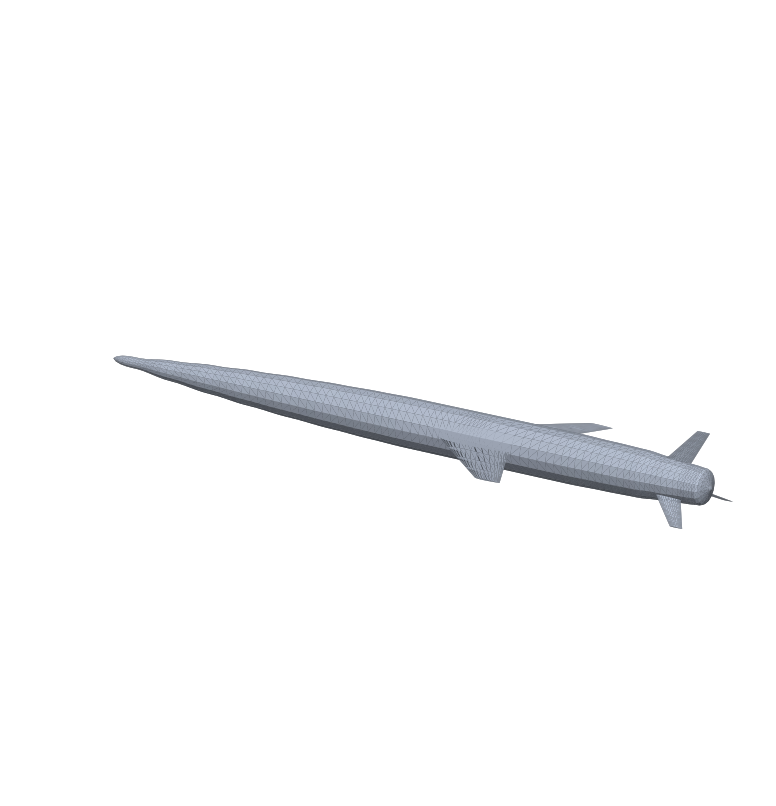
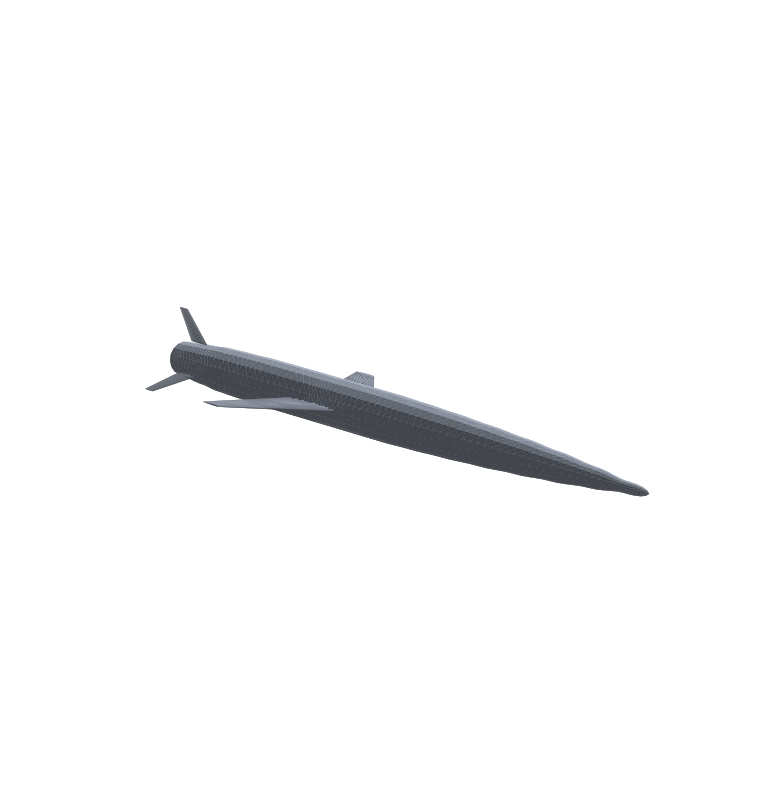
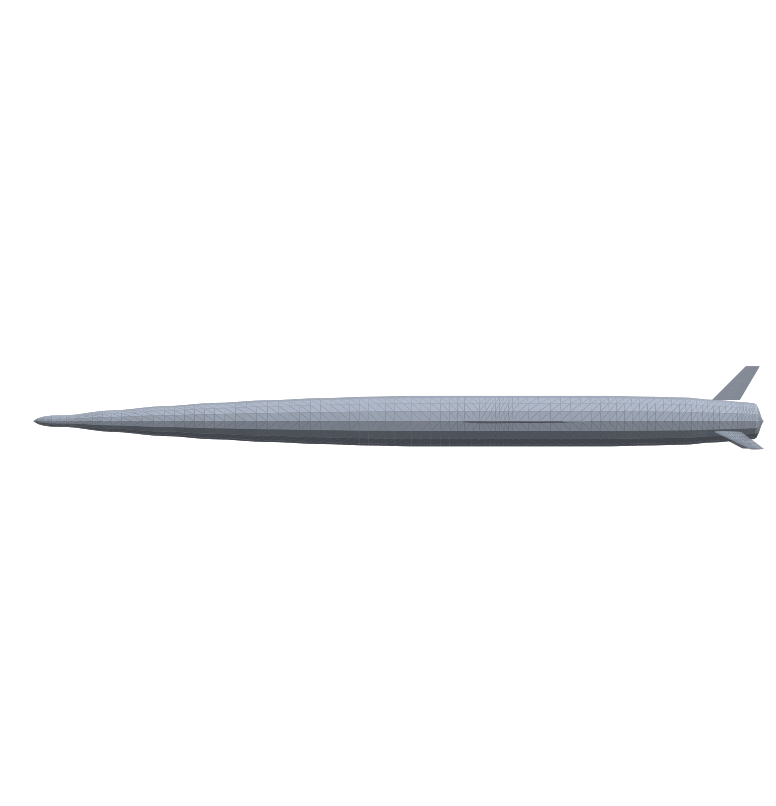
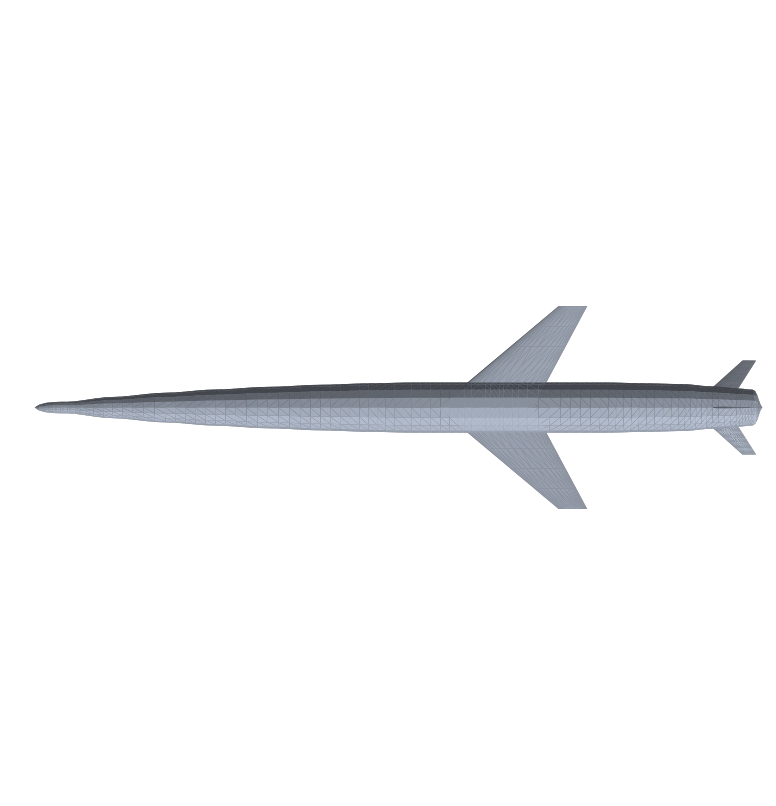
The current baseline: a JetCat P550-PRO inside a 3.05 m long, 210 mm diameter area-ruled fuselage, with an annular ramjet wrapped around the engine’s jetpipe in the aft body (a podded ramjet hung on the outside kills the vehicle with wave drag; it has to be integrated inside the mold line). Cruise-climb to 15,000 ft, accelerate level through the sound barrier, hold Mach 1.02+ for the required window, come home and belly-land on a lakebed skid. Simulated thrust margin over drag through the transonic push: 18 percent with worst-case assumptions, 35 percent nominal, on roughly 3.5 to 4 kg of fuel from a 5 kg tank.
The single biggest open risk is no longer aerodynamic, it is combustion: will a flame stay lit in a duct moving at 53 m/s, and relight on command? That question conveniently reduces to a cheap ground rig (a blower, a duct section, and a camping-gas canister), which is the next physical build, and it gates the engine purchase. If the flame holds, this design closes. If it does not, no version of this vehicle works and it is back to the drawing board, which is exactly the kind of thing you want to find out for a few hundred dollars instead of twenty thousand.
The Problems
- How to manufacture
- How to ground test
- How to flight test
- Cost
- Takeoff and Landing
- Controls
- Custom Electronics?
Results So Far
Air Frame Renders
Ramjet Fuel Controller (ECU)
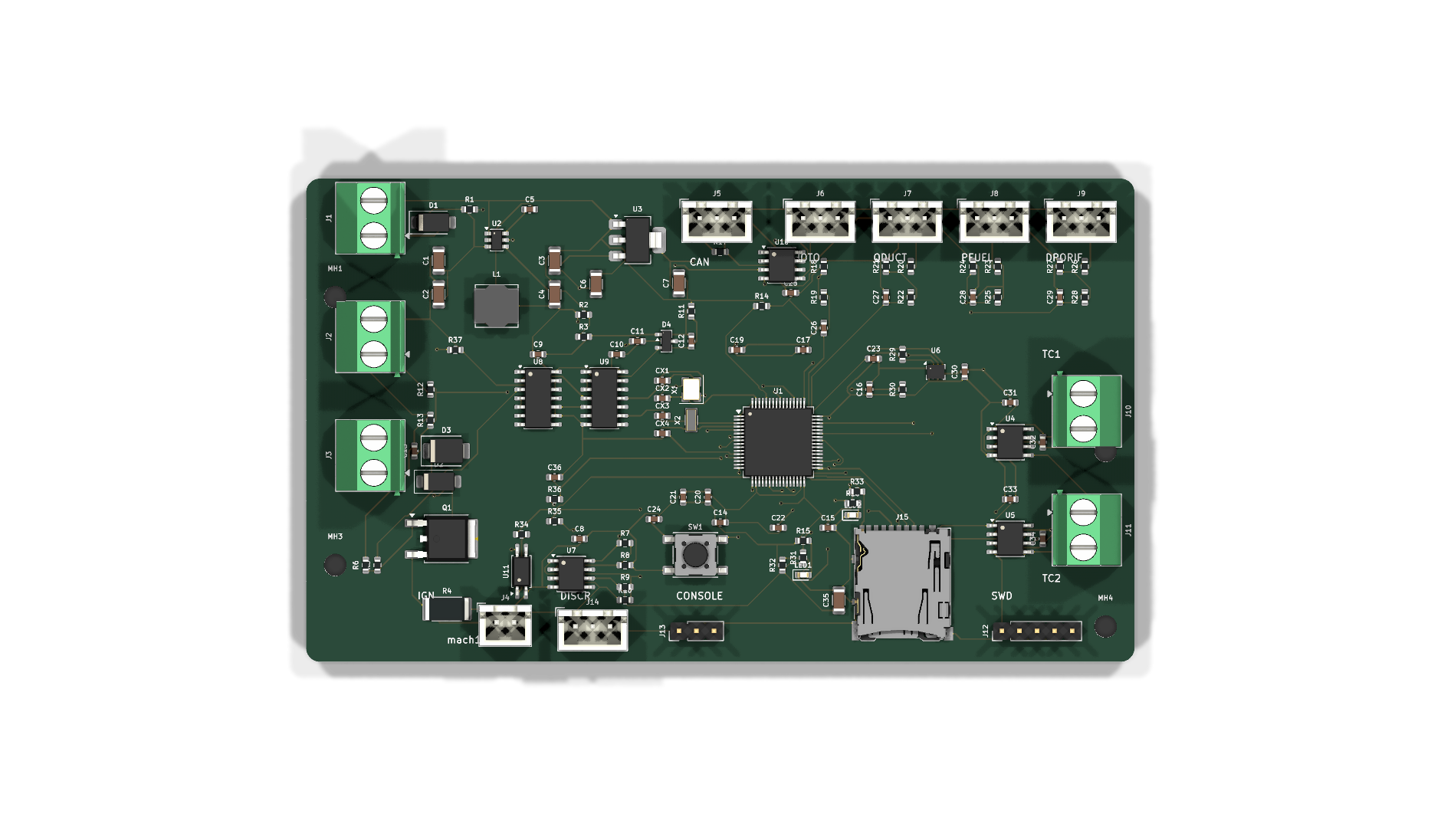
Custom [STM32G4]-based engine control unit - the board that lights and manages
the ramjet. The design phase converged on a stock turbojet + annular ramjet
architecture, which makes this controller the single piece of custom
electronics the propulsion system depends on.
What It Does:
- Staged ramjet fuel delivery (injector/solenoid channels, MOSFET-driven), scheduled against duct conditions
- Flame detection via EGT thermocouple + photodiode, with relight logic
- Hard abort chain: fuel cut on command loss or pilot abort - cutting ramjet fuel instantly reverts the vehicle to benign core-only thrust (this is the safety case, in hardware)
- Sensor interfaces: pitot-static / duct pressure / TAT - per the prize’s measurement & verification requirements